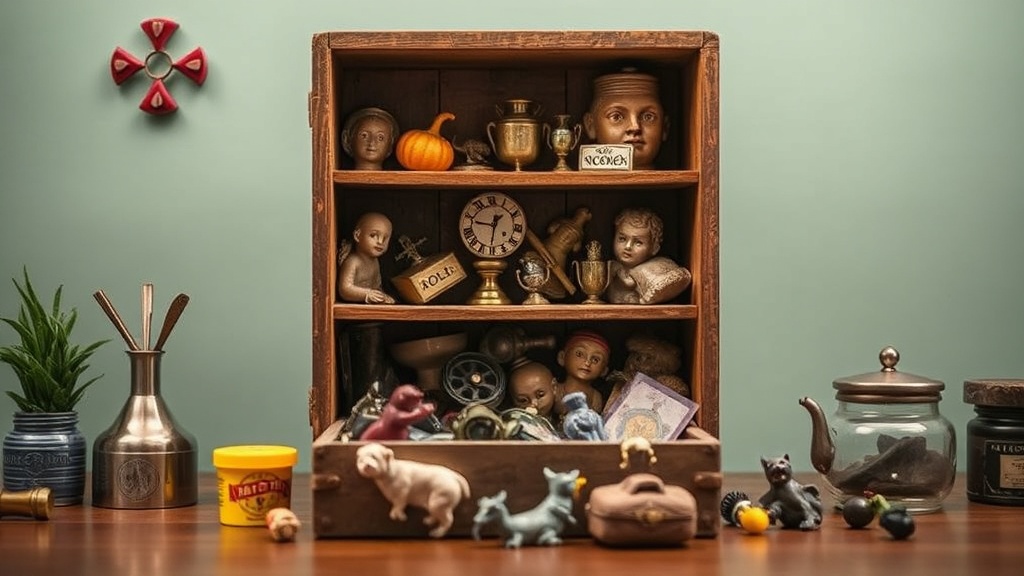
Taming the Tiny Treasures: A Guide to Organizing Small Collections

Taming the Tiny Treasures: A Guide to Organizing Small Collections
We all have them: those small, cherished collections that seem to grow organically, often residing in a forgotten drawer, a dusty box in the back of a closet, or perhaps even a jar on a shelf. Whether it’s a lifetime accumulation of souvenir thimbles, a carefully curated selection of vintage postcards, bottle caps from memorable brews, or a medley of interesting rocks gathered on hikes, these little treasures can quickly become overwhelming. This guide will help you approach these small collections not as clutter, but as an opportunity for thoughtful organization, allowing you to enjoy them without feeling swamped by their presence. We’ll explore practical strategies for sorting, storing, and even displaying these items, transforming potential disarray into delightful displays or neatly contained memories.
Why do small collections become so overwhelming?
It’s a common paradox: something small, accumulated piece by piece, can eventually create a disproportionately large sense of disorder. Part of the challenge comes from their size – tiny items are easy to misplace, hard to categorize, and often don’t fit neatly into standard storage solutions. They tend to be highly sentimental, too, making decisions about what to keep and what to let go of particularly difficult. Each item might carry a story, a memory, or a fleeting moment that you don’t want to discard. This emotional attachment, combined with the sheer volume that accumulates over time, means these collections often multiply quietly until they demand attention. Without a system, they drift from being cherished keepsakes to just another pile of ‘stuff’.
Another factor is the lack of a designated home. Unlike larger possessions that naturally have a spot—a bookshelf for books, a wardrobe for clothes—small collections often lack clear boundaries. They begin in one place, spill into another, and then another, colonizing surfaces and drawers until their presence is felt everywhere. This diffusion makes it hard to get a handle on the actual scope of what you own. Furthermore, the very act of collecting can be a satisfying pursuit, but the organizing aspect often gets deferred. The thrill is in the acquisition, not necessarily the meticulous arrangement. Understanding these underlying reasons helps us approach the task with empathy and a practical mindset, acknowledging that it’s more than just a tidying chore—it’s about respecting your past and creating space for your present.
What's the best way to sort these little treasures?
The first step in tackling any collection, big or small, is a thorough sort. Don’t underestimate this part; it's where you reconnect with your items and make key decisions. Begin by gathering everything related to that specific collection into one place. This means emptying all the drawers, boxes, and nooks where pieces might have migrated. Seeing the full scope of your collection laid out can be a revelation—and sometimes a bit daunting. Grab a few empty containers—baskets, boxes, even just piles on the floor—and label them: “Keep,” “Display,” “Repurpose/Donate,” and “Discard.”
Now, pick up each item individually. Ask yourself a few questions: Does this bring me joy? Does it serve a purpose? Do I have a strong memory associated with it? Is it part of a set I want to maintain? For items that don’t immediately resonate, consider their condition. Is it broken beyond repair? Is it a duplicate? Be honest with yourself. This isn't about ruthlessly decluttering everything, but about making conscious choices. You might find you've kept things out of habit rather than genuine affection. The goal isn't minimalism if that's not your style, but rather mindful curation. For items you’re on the fence about, create a “Maybe” pile and revisit it after you've sorted the clearer categories. Sometimes stepping away and coming back with fresh eyes helps solidify decisions. It’s a process, not a sprint.
Consider also the practicalities. Does an item require special storage or maintenance that you’re unwilling or unable to provide? Are there pieces that, while perhaps interesting, simply don’t fit into your current lifestyle or aesthetic? As you sort, you’ll naturally start to identify sub-categories within your collection. Maybe your bottle caps are best grouped by country of origin, or your postcards by decade. This early categorization will make the next step—storage—much easier. Remember, the sorting process is a chance to define your relationship with your possessions, choosing what truly matters and letting go of what doesn’t. You can find more comprehensive strategies for evaluating items and making decisions from expert sources on organizational psychology, which often underscore the importance of personal connection over sheer volume.